English
 中文简体
中文简体Made of PBS (Polybutylene Succinate), fully biodegradable.Features:1.Home compostable2.Raw material: PBS Polybutylene Su...
READ MORE
Content
DTY (Drawn Textured Yarn) is a type of polyester filament yarn that has been simultaneously drawn and textured through a high-speed false-twist process, giving it a soft, crimped, and elastic structure. Unlike flat yarn, DTY has a natural stretch and a wool-like hand feel, making it one of the most widely used synthetic yarns in the global textile industry. It is the processed form of POY (Partially Oriented Yarn) and serves as a foundational raw material for fabrics ranging from sportswear to home textiles.
DTY is produced from POY (Partially Oriented Yarn) through a process called Draw Texturing, carried out on a Draw Texturing Machine (DTM). The key steps are:
The entire draw-and-texture operation happens in a single pass, making it highly efficient compared to older two-step methods.
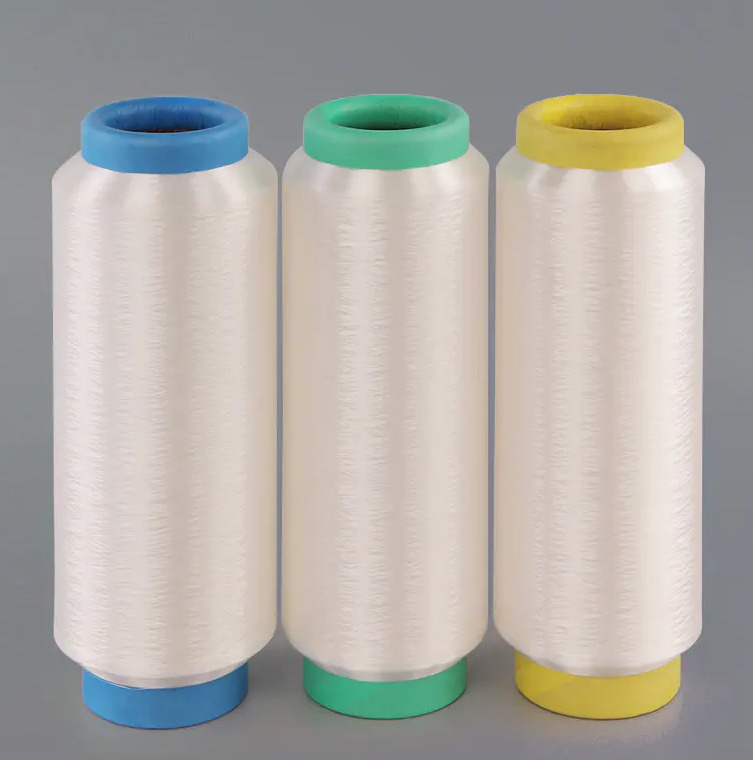
The draw texturing process gives DTY a distinct set of properties that set it apart from other yarn types:
| Property | Typical Value / Description |
|---|---|
| Elongation at Break | 25% – 35% |
| Tenacity | 3.5 – 4.5 g/den |
| Crimp Elasticity | High (filaments spring back after stretching) |
| Bulk / Loft | Significantly higher than flat yarn |
| Moisture Wicking | Moderate (enhanced by microfiber DTY) |
| Dyeability | Excellent with disperse dyes |
| Common Count Range | 30D/24F to 600D/288F |
The "D" in counts like 150D/48F stands for Denier (a unit of yarn linear density), and "F" indicates the number of individual filaments. A 150D/48F DTY is a common general-purpose grade used in woven fabrics and knits alike.
These three yarn types are often confused because they all originate from polyester polymer chips. Here is a clear comparison:
| Attribute | POY | DTY | FDY |
|---|---|---|---|
| Full Name | Partially Oriented Yarn | Drawn Textured Yarn | Fully Drawn Yarn |
| Orientation State | Partial | Fully drawn + textured | Fully drawn, flat |
| Texture / Crimp | None | Yes – bulky and springy | None – smooth and flat |
| Stretch | High (unstable) | Moderate to high (controlled) | Low |
| Primary Use | Feedstock for DTY | Knits, wovens, sportswear | Weaving, sewing thread |
| Hand Feel | Stiff | Soft, wool-like | Smooth, silky |
In summary, POY is the raw input, DTY is the textured and stretched output, and FDY is the flat fully-drawn alternative. Each serves a distinct role in textile manufacturing.
DTY is not a single product — it comes in several variants engineered for different end uses:
The most common variant. Contains a small percentage of titanium dioxide (TiO₂) to reduce luster. Used in everyday apparel fabrics, linings, and home textiles like curtains and bed sheets.
Contains no TiO₂ delustering agent, giving it a high sheen. Preferred for evening wear, activewear, swimwear, and decorative fabrics where shimmer is desirable.
Chemically modified to accept cationic (basic) dyes, which produce deeper and more vibrant colors. It can be woven with standard polyester DTY to achieve two-tone or melange effects in a single dye bath — a popular technique in fashion fabrics.
The filaments are periodically entangled using an air jet, creating cohesion without a twist. This reduces the need for sizing in weaving and improves fabric stability. Common in warp knitting and technical textiles.
Made from filaments finer than 1 denier per filament (dpf). The resulting fabric is exceptionally soft, lightweight, and has good moisture management. Widely used in sportswear, microfiber cleaning cloths, and high-end fashion.
Produced from recycled PET (rPET), typically sourced from post-consumer plastic bottles. Functionally equivalent to virgin DTY but with a significantly lower carbon footprint. Increasingly demanded by sportswear and outdoor apparel brands pursuing sustainability certifications.
DTY's combination of softness, stretch, bulk, and dyeability makes it highly versatile. Key application areas include:
According to industry estimates, polyester DTY accounts for more than 40% of all textured yarn consumed globally, with Asia — particularly China and India — being the dominant production and consumption regions.
When sourcing DTY, you will encounter specifications like 150D/48F SD RW AA NIM. Here is how to decode each element:
Understanding these codes helps buyers specify the exact yarn needed and avoid costly substitutions during production.
When evaluating DTY quality, buyers and fabric mills typically assess the following parameters:
Reputable suppliers provide a Certificate of Analysis (COA) with each shipment detailing these test results against agreed specifications.
Made of PBS (Polybutylene Succinate), fully biodegradable.Features:1.Home compostable2.Raw material: PBS Polybutylene Su...
READ MOREPlease fill out the form below and our team will contact you as soon as possible.
Addres: No.66 Qiaogang Road, Haian, Nantong City, Jiangsu Province, China
E-mail: service@gcfiber.com admin@gcfiber.com
Copyright ? GC FIBER All Rights Reserved. Eco-Friendly Textile Products Manufacturer Biodegradable Yarn Company