English
 中文简体
中文简体Made of PBS (Polybutylene Succinate), fully biodegradable.Features:1.Home compostable2.Raw material: PBS Polybutylene Su...
READ MORE
Content
PLA biodegradable staple fiber is a man-made fiber produced from polylactic acid (PLA), a biopolymer derived from renewable plant-based sources such as corn starch, sugarcane, or cassava. Unlike conventional synthetic fibers made from petroleum, PLA staple fiber can be composted under industrial conditions, making it one of the most commercially viable eco-friendly textile materials available today. It is cut into short, uniform lengths—typically ranging from 32 mm to 64 mm—and processed similarly to cotton or polyester in spinning and nonwoven production lines.
In practical terms, PLA staple fiber bridges the gap between performance and sustainability. It delivers physical properties close to polyester—such as resilience, moisture management, and dimensional stability—while offering a significantly lower environmental footprint across its lifecycle.
The production process of PLA staple fiber follows a well-defined pathway from crop to fiber:
The entire production chain can be designed to be carbon-neutral or even carbon-negative when renewable energy is used, as the plants absorb CO₂ during growth that partially offsets emissions during processing.
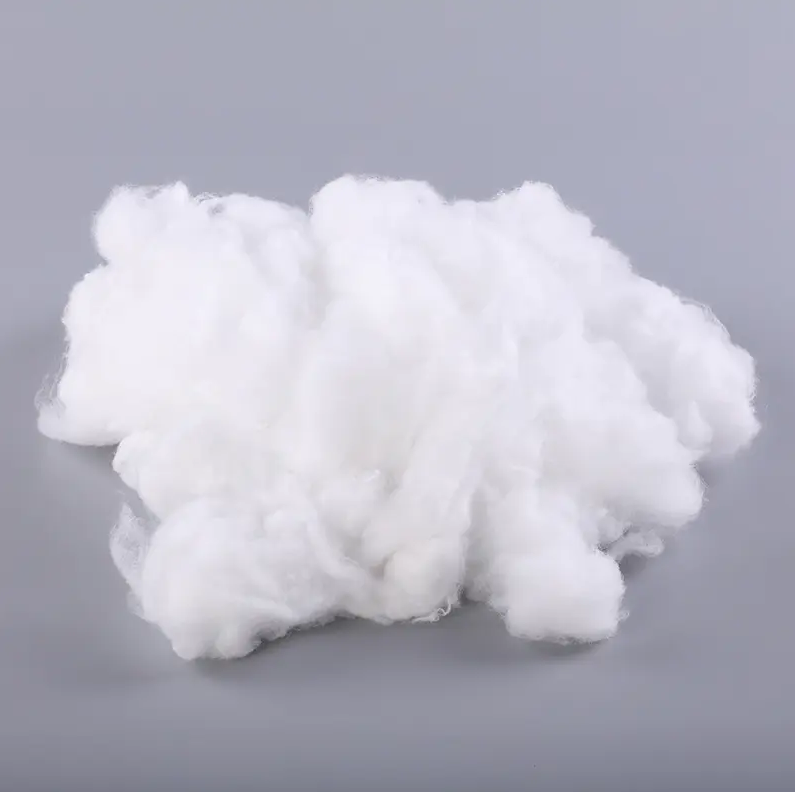
PLA staple fiber offers a distinct combination of properties that make it suitable for a wide range of applications. The table below compares its main characteristics against polyester (PET) staple fiber:
| Property | PLA Staple Fiber | Polyester (PET) Staple Fiber |
|---|---|---|
| Raw Material Source | Renewable (corn, sugarcane) | Petroleum-based |
| Density (g/cm³) | 1.25 | 1.38 |
| Moisture Regain (%) | 0.4–0.6 | 0.2–0.4 |
| Melting Point (°C) | 170–180 | 250–265 |
| UV Resistance | Moderate | Good |
| Biodegradability | Yes (industrial composting) | No |
| CO₂ Reduction vs. PET | ~60% lower GHG emissions | Baseline |
PLA fiber's lower density means that fabrics made from PLA feel lighter than equivalent polyester fabrics at the same weight per square meter—an advantage in apparel and bedding applications. Its natural wicking behavior, slightly better than PET, also makes it comfortable against the skin.
One of the most frequently misunderstood aspects of PLA fiber is the nature of its biodegradability. PLA does not degrade in a typical home compost bin or in the ocean under standard conditions. Industrial composting facilities—maintaining temperatures above 55–60°C and specific humidity levels—are required to break PLA down into water and CO₂ within 90 to 180 days.
Under standard soil or landfill conditions, PLA degrades far more slowly, over several years. This distinction is critical for brands and buyers making end-of-life claims. Products labeled "compostable" should ideally carry certifications such as:
Buyers sourcing PLA staple fiber for sustainability purposes should confirm that their finished product's end-of-life pathway aligns with available composting infrastructure in their target market.
PLA staple fiber is versatile and is increasingly adopted across multiple industries due to both its performance characteristics and its sustainability narrative. Key application areas include:
Nonwovens represent the largest single end-use segment for PLA staple fiber. Applications include disposable hygiene products (wipes, diapers, feminine hygiene), agricultural mulch mats, and single-use medical drapes. The ability to engineer compostable nonwovens is particularly valuable in food service and agriculture, where collection and industrial composting are logistically feasible.
Blended with natural fibers like cotton or wool, PLA staple fiber adds resilience and moisture-wicking function while maintaining a lower environmental impact than pure polyester blends. Several sustainable apparel brands have incorporated PLA fiber into base layers and casual wear collections.
PLA hollow conjugate staple fiber is widely used as a fill material in pillows, duvets, and cushions. Its natural crimp structure gives it excellent loft and bulk recovery, comparable to down-alternative polyester, while offering a bio-based alternative story for eco-conscious consumers.
Geotextiles for erosion control, filtration media, and thermal insulation panels are growing application areas. In these uses, the controlled degradation timeline of PLA becomes a functional feature rather than a limitation—geotextile applications in temporary soil stabilization benefit from the fiber's ability to biodegrade once vegetation is established.
Independent lifecycle assessments (LCA) have consistently demonstrated meaningful environmental advantages for PLA fiber over petroleum-based alternatives:
However, land use and agricultural inputs (pesticides, fertilizers, water for crop cultivation) are areas where PLA's environmental profile requires careful scrutiny. Sourcing PLA resin from certified sustainable agriculture or second-generation feedstocks (non-food biomass) can mitigate these concerns.
Buyers and manufacturers should be aware of several practical constraints when working with PLA staple fiber:
These constraints are manageable with appropriate process adjustments, but they underscore why clear material labeling and separate end-of-life collection systems are important for PLA-based products.
PLA staple fiber is manufactured in a range of specifications to suit different end uses. Buyers typically select based on the following parameters:
| Specification | Typical Range | Application Impact |
|---|---|---|
| Fiber fineness (denier) | 1.0D – 15D | Finer for apparel/wipes; coarser for fill/geotextiles |
| Cut length (mm) | 32 – 64 mm | Matched to spinning system (cotton or worsted) |
| Cross-section | Round, hollow, trilobal | Hollow for insulation loft; trilobal for moisture transport |
| Crimp level | 3–12 crimps/cm | Higher crimp for nonwovens and fill; lower for spinning |
| Color | Raw white, optical white, dope-dyed | Dope-dyed avoids aqueous dyeing for lower water use |
Given the growing market interest in sustainable fibers, it is essential for buyers to distinguish genuinely high-quality PLA fiber from substandard alternatives. Key evaluation criteria include:
The global biodegradable fiber market, of which PLA staple fiber is a major component, is experiencing sustained growth driven by regulatory pressure on single-use plastics, corporate sustainability commitments, and consumer demand for transparency in product origins.
Key trends shaping PLA fiber adoption include:
For textile manufacturers, nonwoven producers, and brands committed to sustainability, PLA biodegradable staple fiber represents one of the most technically mature and commercially scalable bio-based fiber options currently available—provided that end-of-life infrastructure and processing parameters are managed with equal care.
Made of PBS (Polybutylene Succinate), fully biodegradable.Features:1.Home compostable2.Raw material: PBS Polybutylene Su...
READ MOREPlease fill out the form below and our team will contact you as soon as possible.
Addres: No.66 Qiaogang Road, Haian, Nantong City, Jiangsu Province, China
E-mail: service@gcfiber.com admin@gcfiber.com
Copyright ? GC FIBER All Rights Reserved. Eco-Friendly Textile Products Manufacturer Biodegradable Yarn Company