 English
 中文简体
A glove liner can pass ANSI A4 in the lab and still disappoint on the line if the cuff rolls, the liner stiffens after washing, or the yarn loses tenacity from lot to lot.
Cut-resistant HDPE yarn is a high-tenacity polyethylene yarn, often HPPE or UHMWPE, used in an engineered structure that resists blade penetration and survives repeated flexing. The polymer alone is not the product. Tenacity, molecular weight, filament count, twist, sheath material, and the finished knit all decide the cut level and the wearing experience.
That distinction matters when you compare quotes. A commodity HDPE yarn and a gel-spun UHMWPE yarn can both be called "PE," but they do not belong in the same glove liner specification.
What Cut-Resistant HDPE Yarn Actually Means
Cut-resistant HDPE yarn sits in the polyethylene family, but the useful grades are engineered for strength rather than for bags or bottles. High-density polyethylene has a density around 0.94-0.96 g/cm3, low moisture regain, and good chemical resistance; high-tenacity HDPE and UHMWPE raise tensile strength and modulus to levels that can blunt blade engagement in a knit or woven structure.
HPPE is a common commercial label for high-performance polyethylene, usually UHMWPE. Not every HDPE yarn is cut resistant. A standard PE yarn may be perfectly good for netting or cordage and still be the wrong choice for an ANSI A4 liner.
For a base HDPE multifilament rather than a finished composite, high-density polyethylene yarn is the relevant starting point.
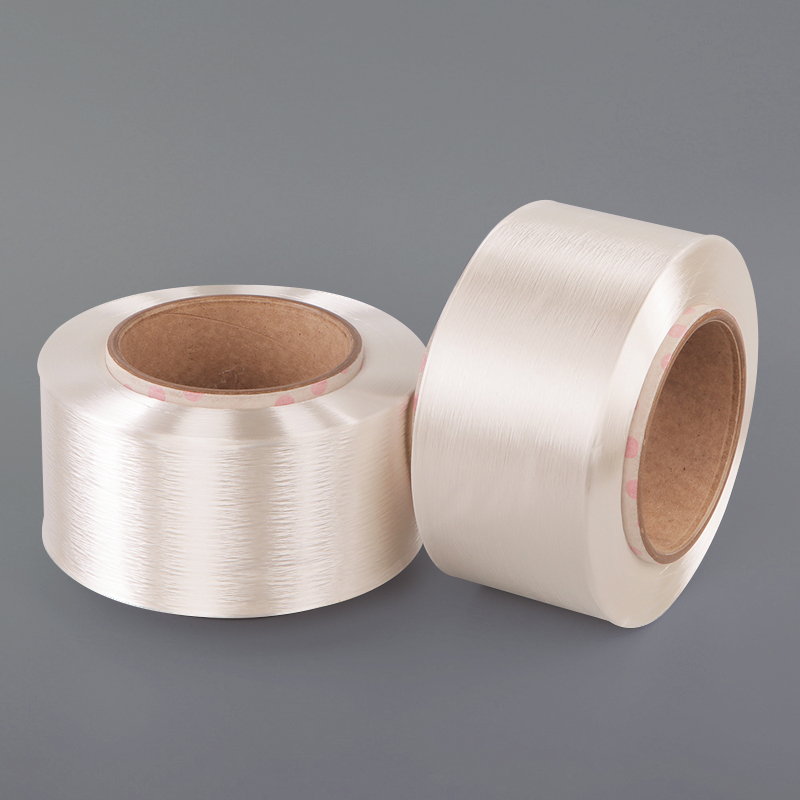 PE Flat FDY Yarn for HDPE Multifilament ApplicationsA base HDPE flat-filament FDY yarn with cooling touch, tenacity and elongation, available in 50D–400D for apparel and industrial fabrics.View Product →
Why HDPE Performs, and Where It Stops
HDPE earns its place in cut-resistant yarn because it combines low density, high tensile strength, and moisture resistance. A lighter liner can reach a given cut level without the weight and stiffness of glass or steel, and the yarn does not absorb much water during washing or storage.
The mechanism is not hardness alone. A high-modulus filament spreads load away from the blade edge and absorbs energy as the blade tries to sever the yarn. In a composite, the HDPE core carries much of that load while the sheath protects the core and improves hand feel.
HDPE also has limits. It softens and melts at roughly 130-135 C, so high-temperature drying, heat setting, or hot coating can damage the yarn. UV exposure outdoors needs stabilization. For the highest cut levels, HDPE is usually blended or wrapped with glass, steel, aramid, or high-strength nylon rather than used alone.
Core-Spun, Covered, and Plied: Construction Decides the Cut Level
The yarn structure often matters as much as the fiber: a high-tenacity HDPE core wrapped with nylon or glass can deliver a better balance of cut resistance, comfort, and durability than an all-HDPE yarn.
| Construction | What it does | Typical use | Watch-out |
|---|---|---|---|
| Core-spun | Spins a staple sheath around a high-tenacity HDPE core. | Glove liners, sleeves, cut-resistant knits. | Sheath wear can expose the core; balance coverage and hand feel. |
| Covered | Wraps a filament or yarn around the core for coverage and smoothness. | Cords, narrow fabrics, composite protective textiles. | Added bulk, stiffness, and cost; check elongation after covering. |
| Plied or twisted | Twists two or more HDPE ends together for strength and process stability. | Ropes, industrial fabrics, knitting and weaving. | Over-twist can reduce strength and flexibility. |
| Blended or inlaid | Combines HDPE with glass, steel, spandex, or nylon. | Higher cut levels, stretch liners, detectable PPE. | Too much glass feels stiff; too much spandex can lower cut resistance. |
For glove liners, a common route is a high-tenacity HDPE core with a nylon or polyester sheath, sometimes with a fine glass filament for higher cut levels. For sleeves and narrow fabrics, a covered or plied structure may be easier to process and more abrasion resistant. The right answer depends on the knitting machine, the coating, and the test method, not on the fiber name alone.
What to Specify Before You Buy
Ask for numerical yarn data and a made-up test report, not a single cut level on a datasheet. The purchase order should lock the properties that change cut performance and processing yield.
- Tenacity: request the grade, average value, and lot-to-lot CV. A high average with wide variation is a production risk.
- Elongation at break: too low can cause brittle processing; too high can reduce load transfer in the finished structure.
- Denier and filament count: agree on a tolerance, for example +/-3-5% on denier, and check that filament count matches the sample.
- Twist and finish: twist affects strength and hand feel; lubricant and sizing affect coating adhesion and knitting efficiency.
- Heat and UV exposure: confirm drying temperature and any UV stabilization if the product will be laundered or used outdoors.
- Traceability: keep lot numbers, resin source, and test data linked to each shipment.
If you need a high-tenacity base rather than a commodity PE yarn, review high-tenacity HDPE yarns before fixing the final specification.
Testing: Yarn Data Is Not a Glove Rating
A yarn cannot carry an ANSI/ISEA cut level by itself; the rating belongs to the finished glove, sleeve, or fabric tested under the standard. ANSI/ISEA 105 uses cut levels A1-A9, while EN 388 uses the TDM test based on ISO 13997, reported as levels A-F.
That is why two liners made from the same HDPE yarn can score differently. Knit density, coating, fit, laundering, and the blade used in the test all change the result. A supplier should show test reports for the made-up article, not just a yarn tenacity certificate. For high-risk applications, also check abrasion, tear, puncture, and grip because cut resistance is only one part of the hazard.
Five Purchasing Risks That Show Up After Production
Most cut-resistant yarn failures are not sudden; they appear as lot drift, liner stiffness, or early wear at the thumb web.
- Tenacity drift. Resin or process changes can lower strength without changing the datasheet cover page. Require lot-specific COA data.
- Filament damage. Poor guides, over-twisting, or rough winding create fuzz and weak points that reduce cut performance.
- Finish incompatibility. A lubricant that helps knitting can hurt coating adhesion or washing performance. Specify the finish, not just the yarn count.
- Heat damage. HDPE softens near 130-135 C. High drying temperatures can flatten the yarn and reduce resilience even when the liner still looks acceptable.
- Core/sheath imbalance. Too much glass makes the liner stiff; too much spandex improves fit but can lower cut resistance. Balance the structure against the test result.
Where Cut-Resistant HDPE Yarn Fits
Cut-resistant HDPE yarn is used where light weight, moisture resistance, and repeated flexing matter as much as peak cut force. Typical uses include glove liners and sleeves for handling sharp metal, glass, and plastic parts; protective apparel; ropes and cordage; safety nets; and industrial fabrics that need high strength with low water uptake.
HDPE is also common in composite cords and narrow fabrics where a high-tenacity core is covered for abrasion resistance. In these applications, the same yarn can be a cut-resistant component, a strength member, or both, provided the construction and test data support the claim.
FAQ
Is cut-resistant HDPE yarn the same as UHMWPE?
No. HDPE is the polymer family. UHMWPE is a very high molecular weight grade, and HPPE is a commercial term often used for UHMWPE. Some cut-resistant yarns use high-tenacity HDPE rather than UHMWPE, so ask for the exact grade and tenacity.
Does higher denier always mean better cut resistance?
No. A thicker yarn can carry more material, but cut resistance also depends on tenacity, filament count, twist, sheath, knit structure, and coating. A high-denier commodity yarn can underperform a well-engineered finer yarn.
Can HDPE cut-resistant yarn be washed?
Yes, but the care condition matters. HDPE has low moisture regain and good chemical resistance, yet high drying temperatures can soften or deform it. Test the finished liner after the expected number of wash cycles, especially if coatings or finishes are present.
What should I ask for in a first sample?
Ask for yarn tenacity and elongation, denier and filament count, twist, finish, and a finished-item cut test to ANSI/ISEA 105 or EN 388. Add abrasion and wash data if the product will be reused in a wet or dirty environment.
A Practical Sourcing Position
Specify cut-resistant HDPE yarn as a system: polymer grade, yarn construction, and finished-item test data should line up. Start with the hazard and the required cut level, then choose the HDPE grade and composite structure that meet it without making the liner stiff or difficult to knit.
At GC FIBER, HDPE yarns can be developed around denier, tenacity, and downstream construction so the yarn specification matches the glove or sleeve being tested. The earlier that conversation starts, the fewer surprises appear in the first bulk lot.