English
 中文简体
中文简体It is made with Bio-base PLA, fully biodegradable Feature: 1. Industrial compost product 2. Made with PLA 3. Eco-frie...
READ MORE
Content
Choosing the best polyester finest yarn comes down to three core factors: denier count, twist level, and intended end use. For most textile and knitting projects, a yarn in the 75D to 150D range with a consistent filament count and smooth surface finish delivers the best balance of softness, strength, and workability. Once you understand these fundamentals, selecting the right yarn becomes a systematic process rather than guesswork.
Polyester finest yarn refers to high-tenacity or micro-denier polyester filament yarn engineered for superior smoothness, uniformity, and performance. Unlike standard polyester, finest-grade yarn undergoes tighter quality control during spinning and drawing, resulting in a more consistent cross-section and fewer surface defects.
These yarns are widely used in apparel fabrics, sportswear, home textiles, embroidery, and technical textiles. The finer the yarn, the closer it mimics the feel of natural silk — which is why the global polyester microfiber market has grown steadily, with demand particularly strong in performance fabric manufacturing.
Understanding what makes a yarn "finest" helps you evaluate products more accurately and avoid paying for specifications that don't match your actual project needs.
Every polyester finest yarn comes with a set of technical specifications. Knowing how to read them saves time and prevents costly project mismatches.
Denier measures the mass in grams per 9,000 meters of yarn. A lower denier means a finer, lighter yarn. Filament count refers to the number of individual fibers bundled together. Common formats include:
A higher filament count at the same denier produces a softer, more lustrous surface because each individual filament is finer.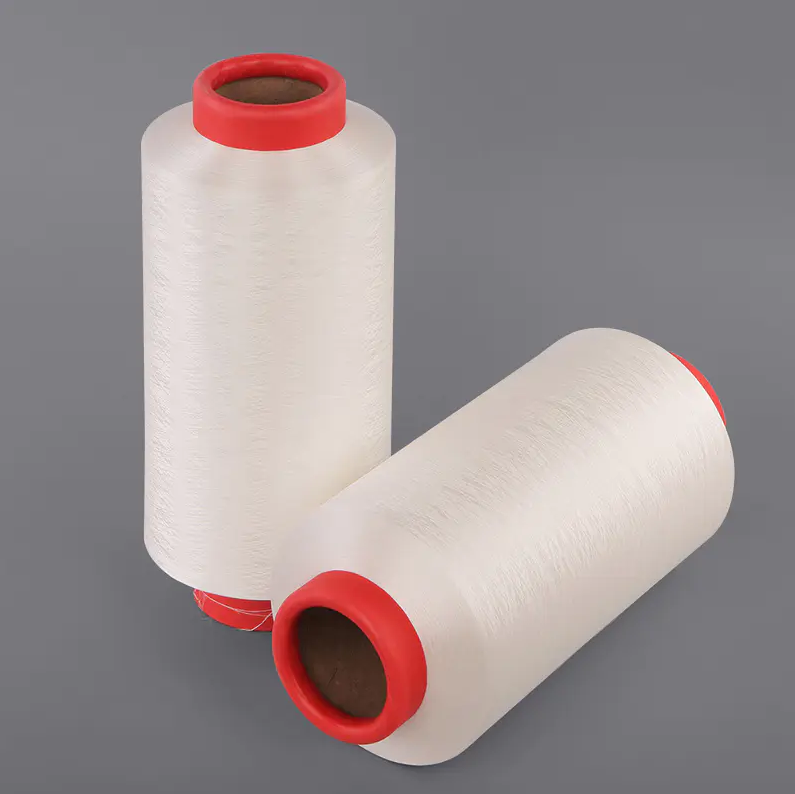
Tenacity (measured in cN/dtex) indicates how much force the yarn can withstand before breaking. High-tenacity polyester yarn typically ranges from 7.0 to 9.5 cN/dtex, compared to 3.5–5.0 cN/dtex for standard grades. For projects requiring durability — such as outdoor gear or upholstery — always select yarn with tenacity above 6.5 cN/dtex. Elongation at break (usually 15–25%) affects how the finished fabric stretches and recovers.
Twist affects both texture and performance. Low-twist yarn (below 100 TPM) has a flatter, more reflective surface suitable for smooth fabrics. High-twist yarn (300–800 TPM) creates a crepe-like texture with better abrasion resistance. Match the twist to your fabric construction and loom or knitting machine type.
Different yarn structures serve different project categories. The table below summarizes the most common types and their best applications:
| Yarn Type | Structure | Key Feature | Best For |
|---|---|---|---|
| Flat Filament | Untwisted or low-twist multifilament | High luster, smooth surface | Linings, scarves, satin fabrics |
| DTY (Draw Textured Yarn) | False-twisted, crimped filament | Stretch, bulk, soft hand | Sportswear, knitted fabrics |
| FDY (Fully Drawn Yarn) | Fully oriented, stable filament | Dimensional stability, uniformity | Weaving, embroidery, technical textiles |
| POY (Partially Oriented Yarn) | Intermediate drawn state | Raw material for texturing | Further processing into DTY |
| Micro Denier Yarn | Below 1.0 dpf filaments | Ultra-soft, silk-like feel | Luxury apparel, intimate wear |
The "best" polyester finest yarn is always project-specific. Using the wrong type — even a high-quality one — leads to fabric defects, poor drape, or processing difficulties.
FDY is the standard choice for warp yarns due to its low elongation and high dimensional stability. A typical specification for woven shirt fabric would be 75D/72F FDY with semi-dull luster. For weft, flat filament or low-twist DTY can add subtle texture without compromising weave integrity.
DTY is the dominant yarn type for circular knitting machines. Its crimp structure gives the knit natural stretch and recovery. 100D/144F DTY is widely used for activewear and leggings. If you need a smoother face for printed knit panels, opt for single-covered or air-covered variants.
Embroidery demands high luster and color vibrancy. Trilobal cross-section polyester finest yarn is the industry standard here — the three-lobed filament reflects light similarly to natural silk, giving embroidery a premium appearance. Look for yarn with a dye uptake rate above 90% and minimal filament breakage during high-speed stitching (above 800 RPM).
Durability and colorfastness matter most. Select high-tenacity yarn with a minimum colorfastness rating of Grade 4 on the ISO 105-B02 light fastness scale. For upholstery, yarn with abrasion resistance exceeding 50,000 Martindale cycles is the industry benchmark for residential use.
Polyester finest yarn is available in three optical finishes, determined by the amount of titanium dioxide (TiO₂) added during manufacturing:
For most everyday apparel projects, semi-dull is the safe default. Bright finish yarn draws attention to surface defects more readily, so it requires tighter quality control during weaving or knitting.
Not all yarn labeled "finest" meets consistent standards. When evaluating suppliers or product samples, check for the following:
Reputable manufacturers provide third-party test reports covering tenacity, elongation, CV%, and shrinkage. If a supplier cannot provide these, treat it as a red flag.
The polyester finest yarn market now includes several functional variants that add performance or environmental value without compromising fiber quality:
Made from post-consumer PET bottles or industrial waste, rPET finest yarn has reached near-parity in quality with virgin polyester in many specifications. Leading-grade rPET yarn achieves tenacity levels of 7.0–8.5 cN/dtex — sufficient for most apparel and home textile applications. Certifications to look for include GRS (Global Recycled Standard) and OEKO-TEX STANDARD 100.
Cross-sectional engineering allows manufacturers to modify filament shape — using trilobal, hollow, or channel-shaped cross-sections — to enhance moisture transport. These yarns move sweat away from skin up to 40% faster than round-filament equivalents in controlled wicking tests, making them suitable for athletic and performance apparel without requiring chemical finish treatments.
Standard polyester requires disperse dyes at high temperatures (130°C). Cationic dyeable polyester (CDP) accepts cationic dyes at lower temperatures, enabling two-tone dyeing effects and reducing energy consumption during dyeing by approximately 20–30%. This is a valuable option for fashion fabrics requiring distinctive color contrast in a single fabric structure.
Before placing any order, run through this decision checklist to ensure the yarn matches your full project requirements:
Following this process systematically eliminates most sources of yarn-related project failure and gives you a clear basis for comparing options across suppliers.
It is made with Bio-base PLA, fully biodegradable Feature: 1. Industrial compost product 2. Made with PLA 3. Eco-frie...
READ MOREPlease fill out the form below and our team will contact you as soon as possible.
Addres: No.66 Qiaogang Road, Haian, Nantong City, Jiangsu Province, China
E-mail: service@gcfiber.com admin@gcfiber.com
Copyright ? GC FIBER All Rights Reserved. Eco-Friendly Textile Products Manufacturer Biodegradable Yarn Company