English
 中文简体
中文简体It is made with Bio-base PLA, fully biodegradable Feature: 1. Industrial compost product 2. Made with PLA 3. Eco-frie...
READ MORE
Content
POY yarn (Partially Oriented Yarn) is a semi-finished polyester filament produced by high-speed melt spinning at 3,000–3,600 m/min, where polymer chains are only partially aligned. It serves as the primary feedstock for draw texturing (DTY) and draw winding (FDY) processes, and is the foundation of the global synthetic textile supply chain. If you are sourcing a versatile, cost-effective polyester intermediate for downstream processing, POY Yarn is the industry's starting point.
During melt spinning, molten polyester (PET) is extruded through a spinneret and wound at controlled speeds. At speeds below 2,000 m/min, the filament is virtually unoriented (UDY). At 3,000–3,600 m/min — the POY range — the molecular chains begin to align along the fiber axis but are not fully crystallized. This partial orientation gives POY its defining characteristic: high elongation at break (typically 120–180%) and low tenacity (around 2.0–2.8 g/den), compared to fully drawn yarn (FDY) which achieves tenacity of 3.8–4.5 g/den.
The "partial" state is not a flaw — it is intentional. That latent drawability is precisely what downstream texturing machines exploit to produce the final yarn characteristics required by fabric manufacturers.
Understanding where POY fits requires comparing it directly with the other major polyester yarn types:
| Property | POY | FDY | DTY |
|---|---|---|---|
| Full Name | Partially Oriented Yarn | Fully Drawn Yarn | Draw Textured Yarn |
| Winding Speed | 3,000–3,600 m/min | 4,500–6,000 m/min | Derived from POY |
| Elongation at Break | 120–180% | 25–45% | 20–35% |
| Tenacity (g/den) | 2.0–2.8 | 3.8–4.5 | 3.2–4.0 |
| Primary Use | Feedstock for DTY/FDY | Weaving, knitting directly | Knitting, stretch fabrics |
| Shelf Life | ~6 months (structure evolves) | Stable, long-term | Stable, long-term |
Source: Textile Technology references, BISFA terminology standards (2022 edition); manufacturer technical datasheets.
The production sequence for POY involves several precisely controlled steps:
The winding speed is the critical variable: it is fast enough to impart molecular orientation, but slow enough to leave the yarn in an amorphous, drawable state. This controlled "incompleteness" is what defines POY.
When procuring POY, buyers evaluate the following parameters. Understanding each one prevents costly processing mismatches:
Standard POY is disperse-dyeable at high temperatures (130 degrees Celsius under pressure). However, fast-fashion and performance segments increasingly demand ambient-pressure dyeing, bright colors, and bi-color fabric effects — requirements that standard PET cannot meet economically.
This is where ECDP POY (Easily Cationic Dyeable Polyester) becomes strategically important. ECDP modifies the PET backbone with sulfonic acid co-monomers (typically 2–3 mol%), introducing anionic dye sites that accept cationic (basic) dyes at atmospheric pressure and temperatures as low as 100 degrees Celsius.
GCF Yarn's ECDP Pre-Oriented POY Yarn delivers this capability in a production-ready feedstock. Key advantages for processors include:
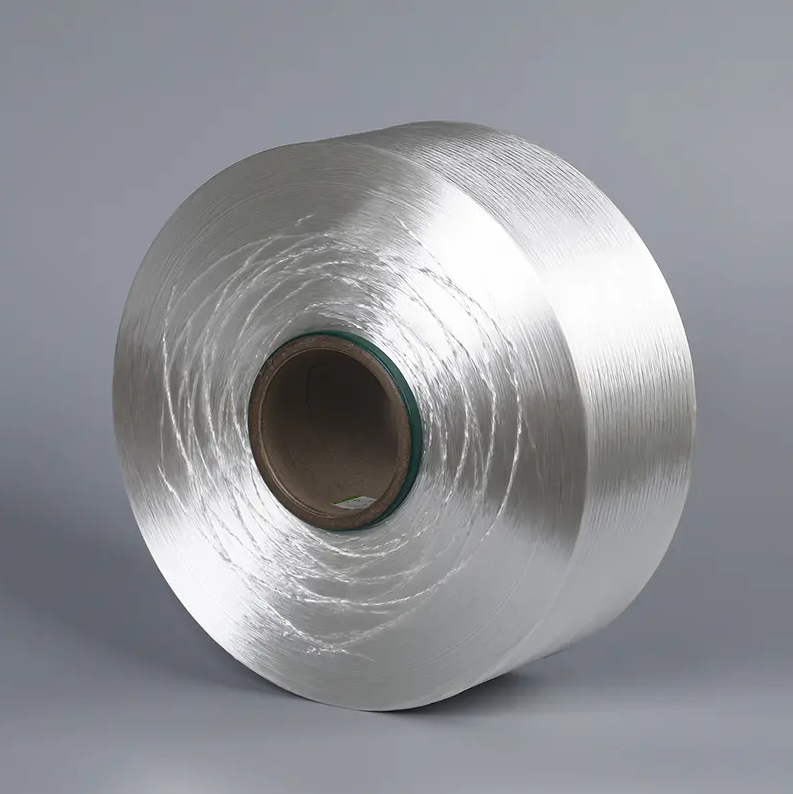
For textile mills looking to differentiate product ranges without capital investment in new dyeing infrastructure, ECDP POY from GCF Yarn offers a practical, low-barrier entry point into atmospheric cationic dyeing.
POY's value is unlocked by two main downstream processes:
Global POY production exceeded 28 million tonnes in 2023, representing roughly 60% of all polyester filament yarn output worldwide (source: PCI Fibres, Global Polyester Filament Market Report, 2024). Several structural factors explain this dominance:
POY is a time-sensitive material. Unlike fully drawn yarns, POY continues to undergo physical aging (structural relaxation and crystallization) after winding. Practically, this means:
Use the following as a practical guide to grade selection:
| Application | Recommended POY Type | Typical Count |
|---|---|---|
| Sportswear / activewear DTY | Semi-dull or bright standard PET POY | 75D/36F – 150D/48F |
| Vivid color / athleisure | ECDP POY (cationic dyeable) | 75D/36F – 150D/48F |
| Two-tone bi-color fabrics | ECDP POY + standard PET POY blend | 100D/36F – 150D/48F |
| Warp weaving (FDY route) | Semi-dull POY, high birefringence | 50D/24F – 100D/36F |
| Home textiles / upholstery DTY | Full-dull POY | 150D/48F – 300D/96F |
Source: Application guidelines derived from industry practice; count ranges representative, not exhaustive.
POY yarn is not a finished product — it is the engineered starting material from which the vast majority of polyester filament fabrics originate. Its partially oriented molecular structure gives it controlled drawability, making it the most efficient and versatile feedstock for draw texturing and draw winding. For buyers requiring enhanced dyeability, energy-efficient processing, and design differentiation, specialty grades such as ECDP Pre-Oriented POY Yarn extend these advantages further. Selecting the correct POY specification — denier, luster, polymer type, and birefringence — is the single most consequential upstream decision in a polyester yarn supply chain.
It is made with Bio-base PLA, fully biodegradable Feature: 1. Industrial compost product 2. Made with PLA 3. Eco-frie...
READ MOREPlease fill out the form below and our team will contact you as soon as possible.
Addres: No.66 Qiaogang Road, Haian, Nantong City, Jiangsu Province, China
E-mail: service@gcfiber.com admin@gcfiber.com
Copyright ? GC FIBER All Rights Reserved. Eco-Friendly Textile Products Manufacturer Biodegradable Yarn Company