 English
 中文简体
中文简体Feature:
1. Soft feel
2. High tenacity and easy rewind
3. 85 degree melting point
4. Bonding agent

A sourcing manager recently asked us whether switching a standard polyester yarn to a recycled polyester yarn would make her collection sustainable. Our answer was not a simple yes or no. Recycled polyester is a meaning...
READ MOREWhen you are choosing a yarn for a product that will face salt water, heavy friction, or months of humidity, polyester and nylon usually come up first in the discussion. Polypropylene yarn should be on that shortlist to...
READ MOREWhat Is Polyester Staple Fiber? Polyester staple fiber (PSF) is a short-length fiber extruded from polyethylene terephthalate (PET) and cut into defined lengths, usually between 3 mm and 150 mm. Unlike filament yarn, wh...
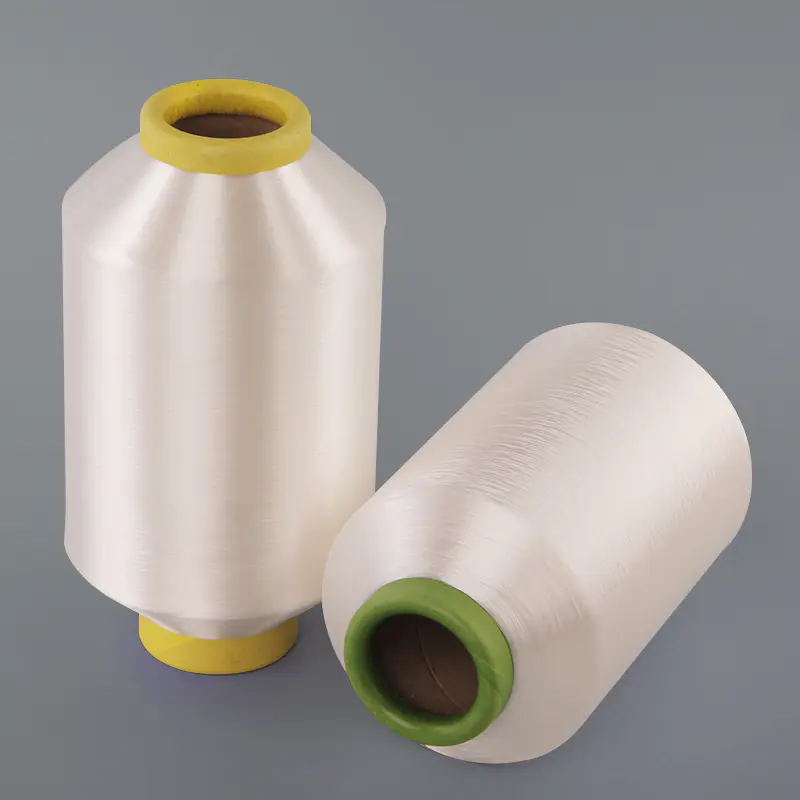
READ MOREPure Nylon Low Melting Yarn 85 Degree is a thermoplastic nylon based hot melt yarn engineered to soften and bond at a low activation temperature close to 85 degrees Celsius, making it one of the lowest activation points available among low melt nylon yarns on the market today. Unlike ordinary nylon filament yarn that requires high heat for shaping or bonding, this yarn is built from a co polyamide structure that allows it to fuse fabrics, trims, webbing, and nonwoven layers together without stitching, without solvent adhesives, and without damaging heat sensitive materials nearby. It is used heavily in footwear lining, bag reinforcement, apparel interlining, medical padding, and technical textile lamination where a gentle bonding temperature protects delicate face fabrics such as mesh, lace, and coated fabrics. The short version: if a project needs a strong bond formed at a low oven or press temperature while keeping the yarn one hundred percent nylon rather than a polyester blend, this is the material category to specify.
The reason this yarn melts so much lower than standard nylon 6 or nylon 66 filament comes down to polymer chemistry rather than any coating or surface treatment. Regular nylon 6 filament typically has a melting range around 215 to 220 degrees Celsius, while nylon 66 sits closer to 255 to 265 degrees Celsius. Low melting nylon yarn is instead built from a modified copolyamide chain where the regular, orderly crystal structure of pure nylon is intentionally interrupted. This interruption lowers the crystallinity of the polymer, which in turn lowers the temperature at which the chains begin to slide past one another and soften into a bonding state.
A grade rated at 85 degrees sits at the softer end of the low melt spectrum, well below the more common 110 degree, 120 degree, and 130 degree low melt nylon grades. This lower rating is intentional for applications where the surrounding fabric or foam cannot tolerate higher press temperatures, such as thin technical mesh, laminated foam cushioning, or pre dyed fabric that would discolor or shrink under stronger heat.
Buyers sourcing this yarn should compare suppliers against a consistent specification sheet. Below is a representative specification table covering the properties most commonly requested by garment, footwear, and technical textile manufacturers.
| Property | Typical Value | Notes |
|---|---|---|
| Material composition | 100 percent nylon copolyamide | No polyester content |
| Softening onset | 78 to 82 degrees Celsius | Gradual softening begins slightly before full melt |
| Full melting point | 83 to 87 degrees Celsius | Centered around 85 degrees Celsius |
| Denier range | 20D to 210D | Fine denier for lace and mesh, heavier for webbing |
| Filament type | Mono or multifilament | Multifilament preferred for knit and weave |
| Color options | Raw white, dyed, black | Raw white most common for interlining |
| Elongation at break | 25 to 45 percent | Varies with denier and draw ratio |
| Standard packaging | Cone or bobbin, 1 to 5 kilograms | Cone winding common for knitting machines |
Understanding the bonding mechanism helps buyers set correct machine parameters and avoid wasted trial runs. The process generally follows four stages regardless of whether the yarn is knitted, woven, or laid as a net structure.
As temperature rises past roughly 78 degrees Celsius, the yarn surface begins to lose rigidity and becomes tacky without fully liquefying.
Between 83 and 87 degrees Celsius the yarn reaches its flow point, allowing it to penetrate into the fibers of the adjoining fabric layer under light pressure.
A press, roller, or laminating belt applies light to moderate pressure, typically between 0.2 and 0.4 megapascal, forcing the melted yarn into intimate contact with the target surface.
Once cooled below the melting range, the yarn re solidifies and locks the two layers together, forming a bond that resists separation under normal wear, washing, and flexing conditions.
Because the 85 degree grade activates at such a gentle temperature, it is chosen specifically for materials that cannot survive the higher heat needed by standard low melt yarns. Common application areas include the following.
Low melt nylon yarn is sold across several melting bands, and choosing the wrong one is the most common sourcing mistake. The table below compares the 85 degree grade with the more common 110 degree and 130 degree grades.
| Grade | Activation Temperature | Best Suited For |
|---|---|---|
| 85 degree grade | 83 to 87 degrees Celsius | Heat sensitive mesh, lace, foam, pre dyed fabric |
| 110 degree grade | 105 to 115 degrees Celsius | General interlining and shoe components |
| 130 degree grade | 125 to 135 degrees Celsius | Heavy webbing, luggage panels, industrial bonding |
The general rule buyers follow is to select the lowest melting grade that still meets the required bond strength, since lower activation heat reduces energy cost, shortens press cycle time, and protects sensitive face fabrics from scorch marks or shrinkage.
Some low melt yarns on the market are actually polyester based or a nylon polyester blend. Choosing a pure nylon version carries specific practical benefits worth noting.
Nylon accepts acid dyes more readily than polyester, so pure nylon yarn matches shade cards used for nylon fabric more closely, reducing visible seam lines after bonding.
Nylon retains a softer hand feel once it resolidifies compared with polyester based low melt fiber, which is important for garments worn against skin.
When the outer fabric is also nylon, using a matching pure nylon low melt yarn improves chemical compatibility at the bond line, which supports a stronger and more durable fusion point.
Because the yarn activates at a low temperature, over pressing is a common error that leads to yarn migration or a stiff, glassy bond line. The following parameter ranges are a practical starting point before fine tuning on production equipment.
| Parameter | Suggested Range |
|---|---|
| Press temperature | 90 to 100 degrees Celsius |
| Dwell time | 8 to 15 seconds |
| Applied pressure | 0.2 to 0.4 megapascal |
| Cooling time before handling | 10 to 20 seconds |
Running a small test batch across three or four temperature settings before committing to full production remains the most reliable way to lock in a bond that is strong but does not leave surface marking on the face fabric.
Because this yarn softens at such a low temperature, storage conditions matter more than they do for standard nylon filament. Cones or bobbins should be kept in a cool, dry area away from direct sunlight and away from any heat source such as a warehouse roof exposed to strong sun, since ambient warehouse temperatures above 40 degrees Celsius over long periods can cause cones to soften slightly and stick together in storage.
When comparing suppliers, buyers should ask for a differential scanning calorimetry report showing the exact melting curve of the batch being quoted, since the number printed on a spec sheet can vary slightly between production lots. A supplier that willingly shares this testing data, along with denier tolerance and dye lot consistency information, is generally a stronger long term sourcing partner than one that only provides a single headline number. It also helps to request a small trial cone before committing to a bulk order, since bonding performance can only be confirmed by testing the yarn against the actual face fabric and foam or lining material used in the finished product.
Yes, when used as a reinforcement or tacking yarn rather than the sole structural component. It is commonly paired with stitching or a secondary support layer in areas that face repeated flexing such as the toe box or heel counter.
Once properly bonded and cooled, the finished bond generally withstands normal home washing at moderate temperature and standard dry cleaning solvents, though it should not be exposed to high heat tumble drying since that can approach the reactivation range of the yarn.
No special needle is required for handling the yarn before bonding, though a slightly larger needle eye can help reduce friction heat build up when working with finer denier low melt yarn on high speed machines.
Excess heat can cause the yarn to over flow, migrate through thin face fabrics, or leave a shiny or glazed mark on the surface. Staying close to the recommended 90 to 100 degree press range while adjusting dwell time is generally safer than raising temperature further.
Dyed versions of the yarn generally hold color well under normal use, but buyers working with strong contrast colors should request a wash fastness test report specific to their chosen shade before large scale production.
Yes, fine denier grades are commonly run on warp knitting and raschel machines to produce net structures used as bonding interlining, provided machine tension is kept moderate to avoid premature softening from friction heat.
Hot melt film bonds as a continuous flat sheet, while low melt yarn can be knitted, woven, or laid into open net structures, allowing breathability and flexibility in the finished bonded fabric that a solid film cannot offer.
Minimum order quantities vary by supplier and denier, though many textile yarn suppliers offer sample cones for testing before requiring a full production quantity commitment.
Please fill out the form below and our team will contact you as soon as possible.
Addres: No.66 Qiaogang Road, Haian, Nantong City, Jiangsu Province, China
E-mail: service@gcfiber.com admin@gcfiber.com
Copyright ? GC FIBER All Rights Reserved. Custom Pure Nylon Low Melting Yarn 85 Degree Manufacturers
