English
 中文简体
中文简体It is made with Bio-base PLA, fully biodegradable Feature: 1. Industrial compost product 2. Made with PLA 3. Eco-frie...
READ MORE
Content
POY (Pre-Oriented Yarn), FDY (Fully Drawn Yarn), and DTY (Draw Textured Yarn) are three distinct forms of polyester filament yarn, each produced through different manufacturing processes and suited for different end uses. In brief: POY is a semi-finished, partially stretched yarn used as feedstock; FDY is a fully drawn, smooth yarn ready for weaving or knitting; and DTY is a textured, elastic yarn created by further processing POY. Choosing the wrong yarn type can significantly affect fabric hand feel, stretch, and production efficiency.
POY is produced directly from the melt-spinning process at relatively high winding speeds — typically between 3,000 and 3,600 meters per minute. At this speed, the polymer chains are only partially oriented, which means the molecular structure is not fully aligned. As a result, POY has lower tenacity and higher elongation compared to fully drawn yarns.
Key characteristics of POY include:
Because POY is an intermediate product, it is rarely used directly in weaving or knitting. Its main role is as raw material for draw texturing machines (to make DTY) or for drawing and winding processes (to make FDY).
FDY is produced at high winding speeds of 5,000–6,500 meters per minute, allowing the polymer chains to be fully oriented and crystallized in a single step. This means FDY does not need further drawing before use. The result is a smooth, lustrous, and strong continuous filament yarn that is ready for direct use in weaving and knitting.
Key characteristics of FDY include:
FDY is widely used in the production of fabrics that require a smooth, shiny surface — such as linings, sportswear fabrics, and woven apparel. It is also used in embroidery threads and sewing threads where consistency and strength are critical.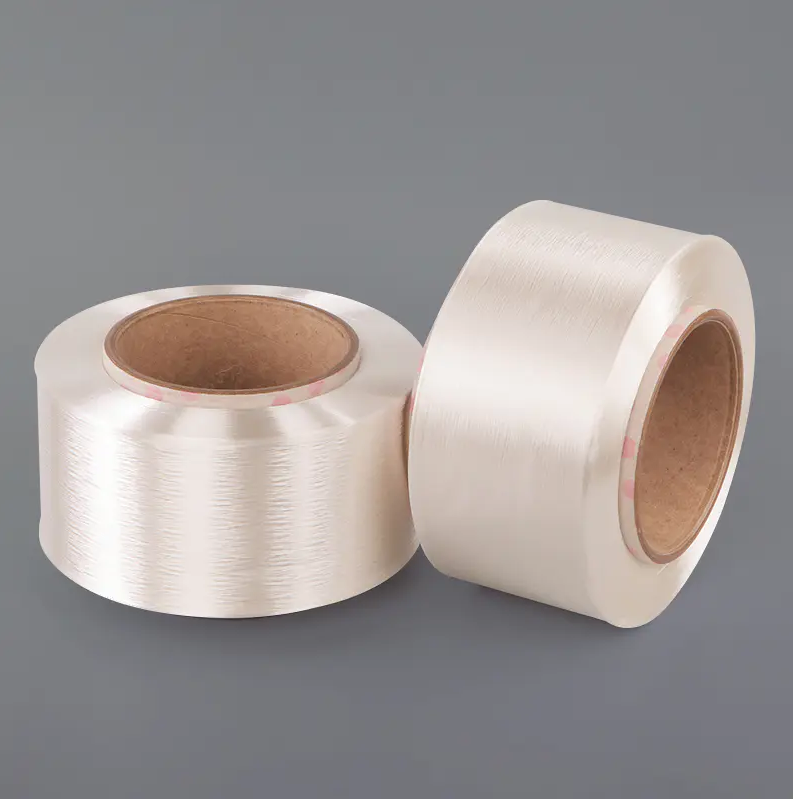
DTY is manufactured by simultaneously drawing and texturing POY on a draw texturing machine. During this process, the yarn passes through a heater zone, a false-twist spindle, and a cooling zone, creating a helical crimp structure in the filaments. This gives DTY its characteristic bulkiness, softness, and stretch.
Key characteristics of DTY include:
DTY is extensively used in knitted fabrics for T-shirts, fleece, leggings, lingerie, and home textiles such as carpets and upholstery. Its soft hand feel and stretch make it the preferred choice wherever comfort is a priority.
The table below summarizes the core technical and application differences among the three yarn types:
| Property | POY | FDY | DTY |
|---|---|---|---|
| Production Speed | 3,000–3,600 m/min | 5,000–6,500 m/min | Depends on DTY machine |
| Molecular Orientation | Partial | Full | Full + Textured |
| Tenacity (g/d) | 2.0–2.5 | 3.5–5.5 | 2.5–3.5 |
| Elongation at Break | 120–170% | 25–40% | 25–35% |
| Texture / Feel | Smooth, semi-finished | Smooth, silky | Soft, bulky, woolly |
| Direct Fabric Use | No (feedstock only) | Yes | Yes |
| Typical Applications | DTY/FDY feedstock | Woven fabrics, linings, embroidery | Knits, fleece, lingerie, home textiles |
Understanding the production route helps explain why each yarn behaves so differently in downstream processing.
Molten polyester is extruded through a spinneret at high speed. The rapid winding speed induces partial chain orientation but insufficient crystallization. This leaves the yarn in a metastable state — it retains the ability to be further drawn, which is essential for DTY production.
FDY is produced on a spin-draw machine that combines spinning and drawing in one continuous step. The yarn passes through godets (rollers) at increasing speeds — the draw ratio is typically 1.5 to 1.7 — which completes the molecular orientation. A final heat-setting step stabilizes the structure, giving FDY its high strength and low elongation.
DTY is made from POY on a draw texturing machine. The yarn is drawn while simultaneously being false-twisted. The false-twist process temporarily twists each filament; heat sets the twist; then the twist is released, leaving behind a permanent helical crimp. A second heater can be used to reduce torque and improve fabric stability — this is known as "set yarn" or "2-heater DTY," which is softer and lower in torque than "1-heater DTY."
Selecting the right yarn depends on the fabric structure (woven vs. knit), the required hand feel, and the performance demands of the end product.
For blended applications — such as a fabric that requires both strength and softness — FDY and DTY are sometimes interlooped in the same knit structure to balance properties.
POY, FDY, and DTY absorb dyes differently, which has real implications for fabric finishing.
Because DTY has a crimped, bulky structure with more fiber surface area exposed, it tends to absorb disperse dyes more readily and evenly. FDY, being a smooth and tightly packed filament, can be harder to dye uniformly at lower temperatures. FDY typically requires dyeing at 130°C under pressurized conditions to achieve good dye penetration.
Cationic-dyeable variants of all three yarn types also exist, where the polyester polymer is modified to accept cationic dyes at atmospheric pressure — useful for achieving deep, vibrant shades without high-pressure equipment.
All three yarn types are available across a wide range of deniers, but typical commercial ranges differ:
| Yarn Type | Typical Denier Range | Common Filament Counts | Luster Options |
|---|---|---|---|
| POY | 75D – 300D | 36f, 72f, 96f | Bright, Semi-Dull |
| FDY | 20D – 600D | 12f, 24f, 36f, 48f, 72f | Bright, Semi-Dull, Full-Dull |
| DTY | 50D – 600D | 36f, 48f, 72f, 96f, 144f | Bright, Semi-Dull, Full-Dull |
Higher filament counts in DTY produce a finer, softer hand feel per denier — for example, 150D/144f DTY is noticeably softer than 150D/48f DTY of the same total denier because each individual filament is finer.
When specifying polyester yarn for a project, keep these practical guidelines in mind:
It is made with Bio-base PLA, fully biodegradable Feature: 1. Industrial compost product 2. Made with PLA 3. Eco-frie...
READ MOREPlease fill out the form below and our team will contact you as soon as possible.
Addres: No.66 Qiaogang Road, Haian, Nantong City, Jiangsu Province, China
E-mail: service@gcfiber.com admin@gcfiber.com
Copyright ? GC FIBER All Rights Reserved. Eco-Friendly Textile Products Manufacturer Biodegradable Yarn Company