English
 中文简体
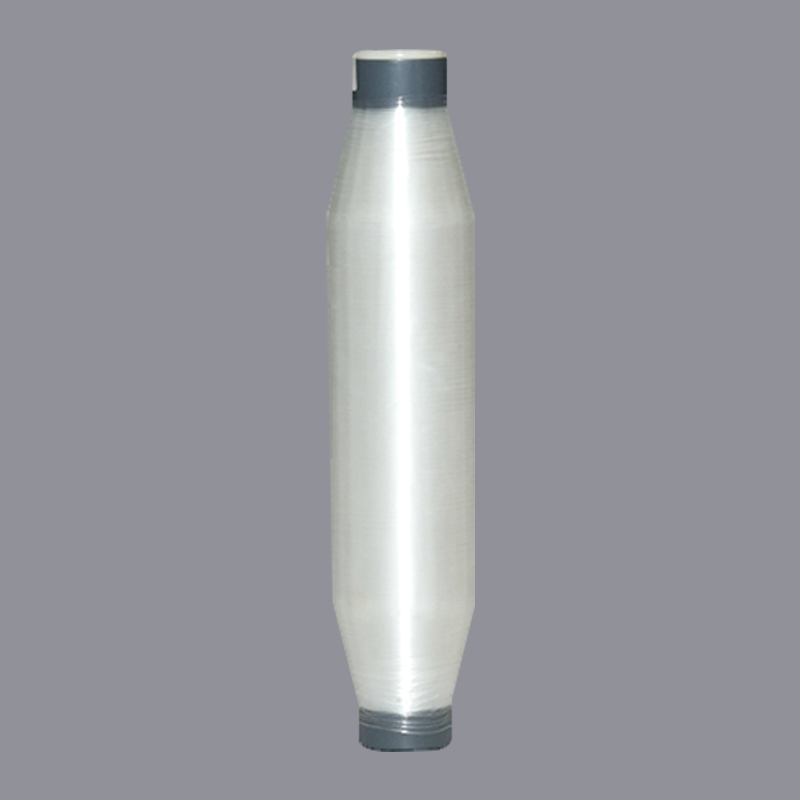
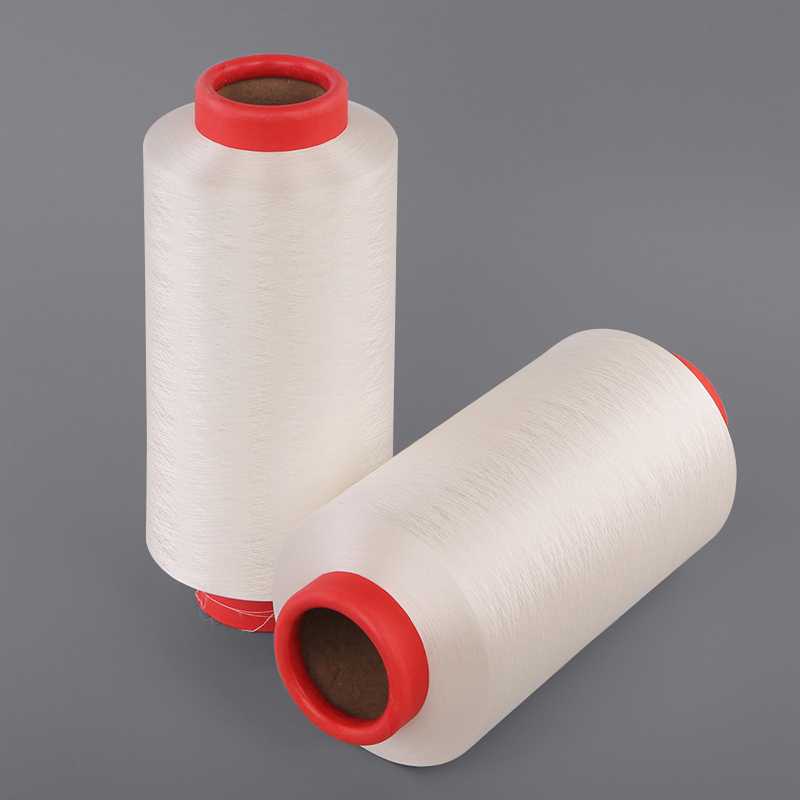
Made of PBS (Polybutylene Succinate), fully biodegradable.Features:1.Home compostable2.Raw material: PBS Polybutylene Su...
READ MORE
Content
Twenty tonnes of yarn almost never fails because the polymer was wrong. It fails because the purchase order listed a denier and a colour but never the number that actually decided the outcome: shrinkage after a 60 °C wash, surface resistivity after twenty abrasion cycles, or the melting point of the sheath layer.
High-performance fibers are defined by a measurable property target, not by a material name. Aramid and carbon sit at one end of that definition; modified polyester, HDPE, bicomponent and PLA sit closer to the other end — and that second group supplies most of the tonnage a textile mill actually runs. Once a buyer accepts that framing, specification, sampling and supplier qualification all become far more concrete.
The working definition used across the industry is narrow and useful: a high-performance fiber shows at least one property far outside the range of conventional textile fibers. For structural grades, that property is usually strength or modulus, with the long-standing reference point sitting near 2 GPa for high-strength, high-modulus types. For textile plants, the extraordinary property is more often functional — permanent antistatic behaviour, a tightly controlled melting range, low-temperature dyeability, or a bicomponent architecture that bonds without added adhesive.
That distinction has commercial consequences. A fiber that is merely better than standard is a commodity with a premium attached. A fiber that meets a number the buyer cannot otherwise reach becomes a specification item, and it is qualified, audited and priced as one.
| Property | Commodity baseline | Functional target | Effect downstream |
|---|---|---|---|
| Tenacity | 3.5–4.5 cN/dtex | 6+ cN/dtex; above 2 GPa for structural grades | Down-gauging without losing strength |
| Hot-air shrinkage | 8–12% at 180 °C | Held inside a narrow band, often under 5% | Dimensional stability after finishing |
| Bonding behaviour | No bonding function | 85 °C or 110 °C melting point; sheath-core design | Thermal bonding replaces adhesives |
| Surface resistivity | 10^14–10^16 Ω | 10^8–10^10 Ω, retained after washing | Static control in workwear, filters, cleanrooms |
| Dyeing temperature | Around 130 °C for deep shades | 85–100 °C with cationic modification | Lower energy use, faster shade correction |
Aramid, carbon, glass and ceramic types carry strength, heat resistance or barrier function into ballistic panels, composites, gaskets and aerospace assemblies. Qualification cycles run for months or years, and the buyer is usually an engineering team working to a standard rather than a fabric developer working to a hand feel.
The second family is where most commercial textile volume lives: modified polyester, high-density polyethylene, PLA, bicomponent and low-melting yarns. These are qualified in weeks, not years, and the conversation is about measurable behaviour in a finished article — an anti-static uniform that stays anti-static, a shoe upper that bonds at 110 °C without yellowing, a sportswear fabric with a cool touch.
Conductive or anti-static polyester is usually judged on two numbers: surface resistivity and how much of it survives repeated washing. A grey anti-static PET yarn and a black anti-static polyester yarn are not interchangeable in a workwear programme, because the carbon loading and the resulting shade and strength differ. Ask for resistivity after ten and twenty wash cycles, not only on the greige bobbin.
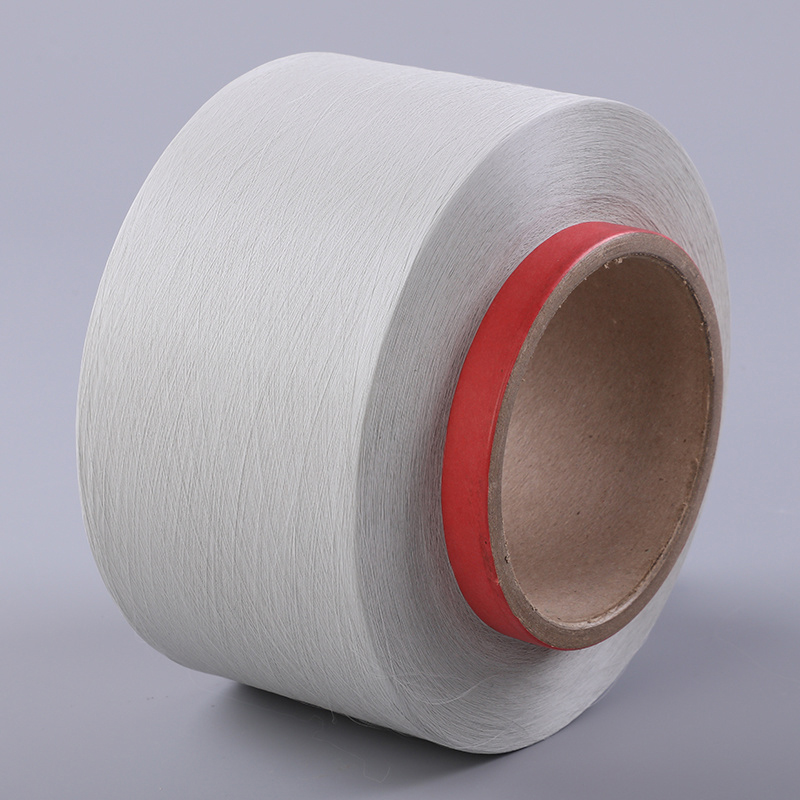 Grey Anti-Static PET Filament Yarn for WorkwearGrey conductive polyester filament with 10^9 Ω/cm surface resistivity, designed to retain static dissipation through repeated washing and low-humidity use.View Product →
Bonding fibers do the quiet structural work in nonwovens, laminated shoe uppers and moulded automotive parts. The two specifications that decide results are melting point — 85 °C and 110 °C grades behave very differently on a calendar line — and architecture, since a sheath-core polyester low-melting yarn melts on the outside while keeping a load-bearing core intact. A 110 °C grade that creeps at 105 °C is a defect, not a tolerance.
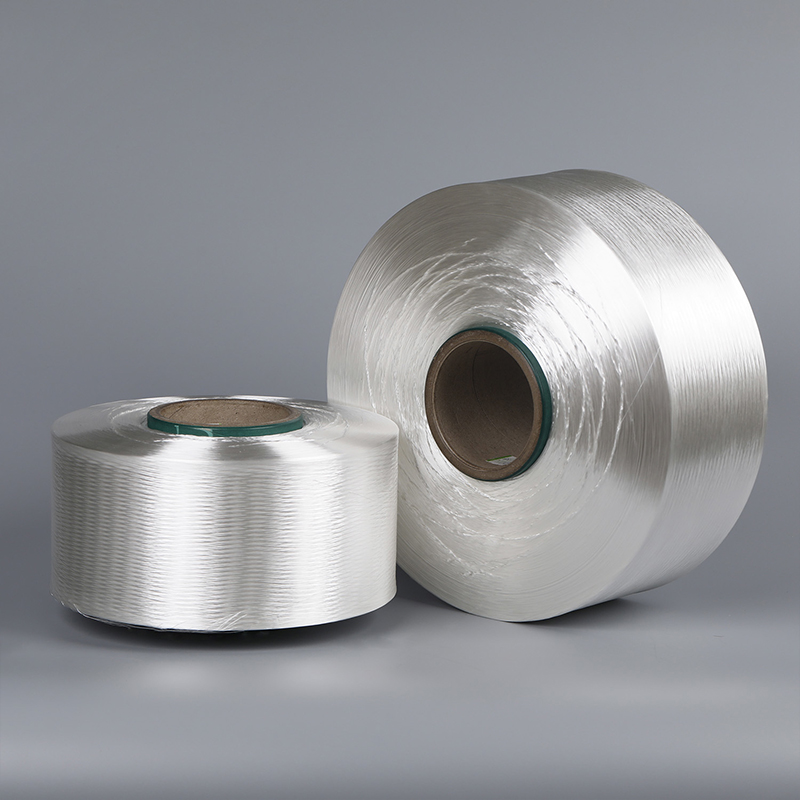 110°C Polyester Low-Melting Bonding Yarn for Shoe UppersPolyester low-melting yarn with about 110°C bonding point and high tenacity, suited to heat-pressing shoe-upper layers without standard polyester's thermal damage.View Product →
ECDP grades are chosen when a dark, saturated shade must be reached below the boil, or when colour flake and batch-to-batch shade drift are costing a dyehouse money. HDPE and PE yarns bring a cooling hand feel together with toughness and elongation; PE/PET and PE/PP bicomponent structures exist to split, bond or soften depending on the process.
PLA filament, staple fiber and nonwoven are specified when end-of-life claims must be defensible, but PLA is moisture sensitive and its hydrolysis behaviour under heat needs to be written into the storage clause. At the fine end, micro filament and finest-denier polyester deliver softness and drape that standard 150D yarn cannot match.
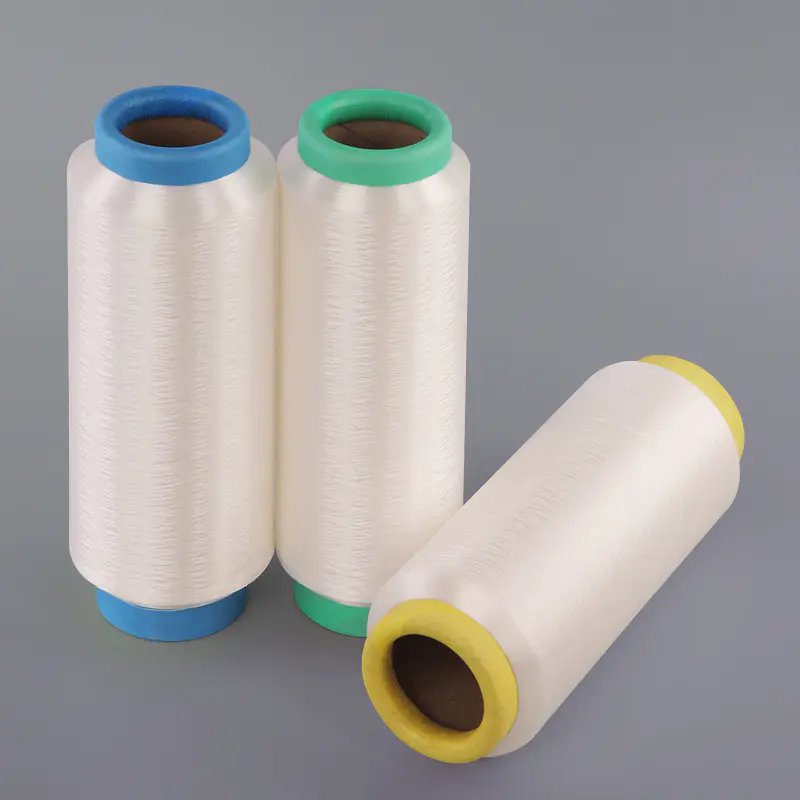 PLA Biodegradable Filament Yarn for Sustainable TextilesPlant-based PLA continuous filament yarn in DTY counts, offering industrial compostability, lower dyeing temperatures and silk-like drape for eco-textile programmes.View Product →
Most disputes trace back to a parameter that was never written down, or was written down without a test method. The table below covers the fields worth locking into a purchase contract before the first sample is even spun.
| Parameter | Usual reporting | What to fix in writing | Cost if omitted |
|---|---|---|---|
| Linear density | dtex or denier, nominal | Tolerance band, e.g. ±3% | Fabric weight drift, rejected lots |
| Filament count | f, e.g. 72f | Exact count and test method | Uneven dye uptake, streaks |
| Tenacity and elongation | cN/dtex and % | Minimum tenacity, elongation range | Yarn breaks, loom stops |
| Shrinkage in hot air | % at stated temperature | Temperature and dwell time | Puckering after heat setting |
| Melting range | Nominal grade (85 / 110 °C) | DSC peak, not catalogue label | Weak bonds, surface damage |
| Spin finish | % by weight | Range plus finish type | Friction faults, poor bonding |
A chemically correct fiber can still ruin a production run. The first variable is spin state: POY, FDY and DTY behave differently on the beam and in the dye bath, and choosing the wrong one is a common and avoidable error — the differences between POY, FDY and DTY yarns are worth reviewing before a new fabric is costed.
The second is moisture. Polyester is forgiving, PLA is not; hydrolysis during storage or high-temperature processing can cut tenacity before the yarn ever reaches a needle. The third is package geometry: bobbin weight, winding density and unwinding tension determine whether a 10 kg package runs clean at 800 m/min or tangles at the creel. Agree the package format, not just the fiber.
A short list that separates a fiber producer from a trader with a catalogue:
Send the target property and the test method together, and a producer can usually answer within days rather than weeks: contact GC Fiber with your specification and let the technical team respond to the number that actually matters.
Buying high-performance fibers is ultimately an exercise in narrowing a definition until it becomes measurable. Structural grades are governed by strength and heat; functional grades by resistivity, melting behaviour, dyeing temperature and longevity in the finished article. Get those numbers into writing, agree how they will be tested, and the fiber stops being a marketing category and becomes an engineering input — which is exactly what the premium is being paid for.
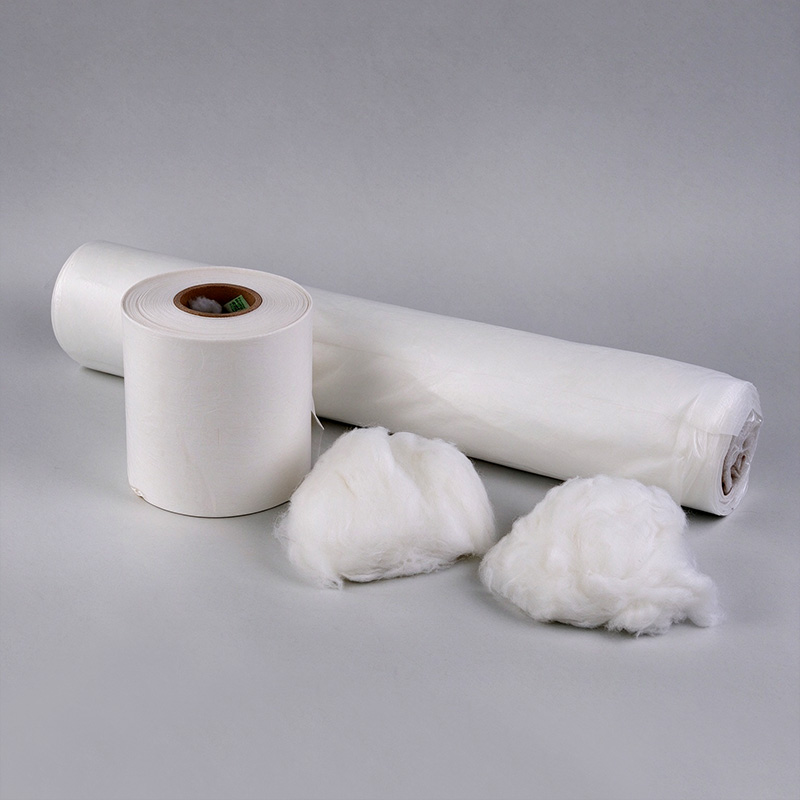
Made of PBS (Polybutylene Succinate), fully biodegradable.Features:1.Home compostable2.Raw material: PBS Polybutylene Su...
READ MOREPlease fill out the form below and our team will contact you as soon as possible.
Addres: No.66 Qiaogang Road, Haian, Nantong City, Jiangsu Province, China
E-mail: service@gcfiber.com admin@gcfiber.com
Copyright ? GC FIBER All Rights Reserved. Eco-Friendly Textile Products Manufacturer Biodegradable Yarn Company