English
 中文简体
中文简体It is made with Bio-base PLA, fully biodegradable Feature: 1. Industrial compost product 2. Made with PLA 3. Eco-frie...
READ MORE
Content
Choosing the right DTY (Draw Textured Yarn) comes down to three core parameters: denier count, twist level (TPI), and fiber composition. Match these to your fabric structure and end-use, and the rest of the decision-making falls into place. DTY yarn is a polyester-based filament yarn that has been textured through a false-twist process, giving it stretch, bulk, and a soft hand feel — making it one of the most versatile yarns in both knitting and weaving applications.
DTY yarn is produced by drawing and texturing partially oriented yarn (POY) through a false-twist texturing machine. The result is a yarn with a crimped, elastic structure that mimics the behavior of natural fibers. Unlike flat polyester filament, DTY has inherent bulk and recovery, which directly affects how a finished fabric drapes, stretches, and feels.
For knitters and weavers, this matters because DTY's textured structure interacts differently with needles, heddles, and tension systems compared to spun yarn or flat filament. Understanding its production characteristics helps you predict the fabric outcome before you even begin.
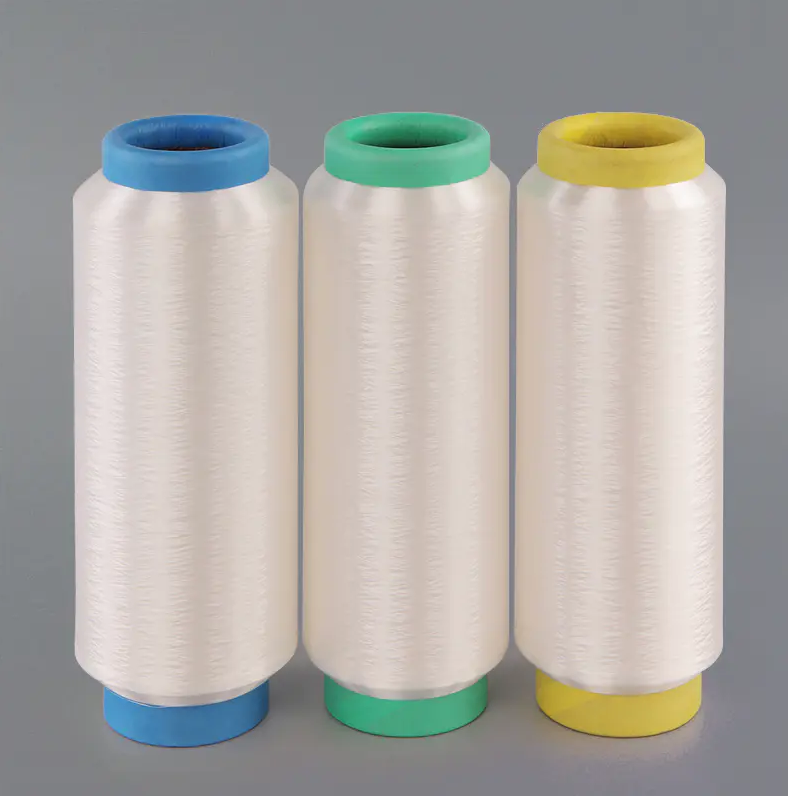
DTY yarn is typically labeled with a specification such as 150D/48F, which means 150 denier total with 48 individual filaments. Understanding this notation is essential before comparing products.
| Specification | Denier | Filament Count | Typical Use |
|---|---|---|---|
| 75D/36F | 75 | 36 | Lightweight lingerie, sports liners |
| 150D/48F | 150 | 48 | Mid-weight knit fabrics, dress fabrics |
| 300D/96F | 300 | 96 | Upholstery, heavy outerwear |
| 450D/144F | 450 | 144 | Industrial woven textiles, bags |
A higher filament count at the same denier means finer individual filaments, producing a softer, more lustrous fabric. For example, 150D/144F produces a significantly silkier hand than 150D/48F, even though both are the same total thickness.
Denier is the single most important factor in matching DTY yarn to your application. It directly controls fabric weight, opacity, and drape. Here is a practical framework for selecting the right range:
Yarns in this range are best suited for fine knit fabrics, athletic wear, and mesh structures. A 75D/72F DTY is commonly used for moisture-wicking sportswear because the high filament count creates more surface area for moisture transport without adding bulk.
This is the most versatile range. 150D/48F is one of the most widely used DTY specifications globally, suitable for warp-knitted fabrics, circular knit jersey, and light woven apparel. It balances coverage, softness, and machine compatibility well.
Deniers above 200 are typically chosen for upholstery, technical textiles, bags, and outerwear. At this weight, fabric stability and abrasion resistance become the priority over hand feel. Weaving applications in this range often use DTY as the weft, pairing it with a more rigid warp yarn.
DTY yarn is available in low twist, medium twist, and high twist versions. Twist per inch (TPI) changes how the yarn behaves under tension, which has very different implications depending on whether you are knitting or weaving.
For warp-knitting machines, a twist imbalance can cause fabric curling or distortion. It is recommended to use balanced S/Z twist pairs when producing flat, stable warp-knit structures.
Most DTY yarn on the market is made from standard polyester (PET), but specialty fiber types significantly expand what is possible in terms of performance and aesthetics.
| Fiber Type | Softness | Moisture Management | Luster | Best For |
|---|---|---|---|---|
| Standard PET DTY | Medium | Low | Semi-dull to bright | General apparel, linings |
| Micro DTY | High | Medium | High | Sportswear, luxury feel fabrics |
| Cationic DTY | Medium | Low | Medium | Two-tone dyeing effects |
| Recycled PET DTY | Medium | Low | Semi-dull | Eco-conscious product lines |
| Nylon DTY | High | Medium | High | Hosiery, swimwear |
Cationic DTY is particularly useful in fabric design because it absorbs disperse dyes at a different rate than standard polyester. When the two types are blended in the same yarn, a single dyebath can produce heather or two-tone color effects without additional processing steps.
DTY yarn's optical quality is controlled by the amount of titanium dioxide (TiO₂) added during fiber production. This directly affects the finished fabric's visual appearance.
When mixing DTY with other yarns in a woven structure, mismatched luster levels between warp and weft can create unintended visual contrast. Always confirm luster compatibility during sampling.
Knitting machine gauge (needles per inch) defines the yarn thickness range the machine can process without tension problems or needle breakage. Selecting DTY yarn outside the compatible denier range leads to fabric defects, yarn breakage, or inconsistent loop formation.
| Machine Gauge (GG) | Recommended DTY Denier | Typical Fabric Type |
|---|---|---|
| 28 GG | 50D – 75D | Fine jersey, hosiery |
| 24 GG | 75D – 150D | Sportswear, underwear fabric |
| 18 GG | 150D – 300D | Fleece, interlock fabrics |
| 12 GG | 300D – 600D | Heavy outerwear, polar fleece |
Beyond gauge, DTY yarn for knitting should have consistent elongation-at-break values across the package to prevent tension variation between the start and end of a cone. Elongation variation of more than ±5% within a single package is a common source of striping defects in circular knit fabrics.
In weaving, DTY yarn behaves very differently depending on whether it is used in the warp or the weft. The warp is under constant tension throughout the weaving process, while the weft is inserted in a relaxed state. DTY is far more commonly used as a weft yarn because its inherent stretch and bulk can cause problems under sustained warp tension.
Even when specifications appear identical between two sources, physical yarn quality can vary significantly. The following tests help verify consistency before committing to a large order.
Avoiding these errors saves significant time and material cost during production:
Use this summary to quickly narrow down the right DTY specification for your project:
| Application | Recommended Denier | Twist Level | Luster | Key Priority |
|---|---|---|---|---|
| Sportswear | 75D–150D | Low–Medium | Full-dull | Stretch recovery, wicking |
| Dress fabrics | 100D–150D | Medium | Bright or semi-dull | Drape, color depth |
| Home textiles | 150D–300D | Medium–High | Semi-dull | Coverage, durability |
| Upholstery / bags | 300D–600D | High | Semi-dull or full-dull | Abrasion resistance, stability |
| Lingerie / hosiery | 20D–75D | Low | Bright | Softness, sheen, fine gauge |
It is made with Bio-base PLA, fully biodegradable Feature: 1. Industrial compost product 2. Made with PLA 3. Eco-frie...
READ MOREPlease fill out the form below and our team will contact you as soon as possible.
Addres: No.66 Qiaogang Road, Haian, Nantong City, Jiangsu Province, China
E-mail: service@gcfiber.com admin@gcfiber.com
Copyright ? GC FIBER All Rights Reserved. Eco-Friendly Textile Products Manufacturer Biodegradable Yarn Company