English
 中文简体
中文简体It is made with Bio-base PLA, fully biodegradable Feature: 1. Industrial compost product 2. Made with PLA 3. Eco-frie...
READ MORE
Content
Low melting yarn is a thermoplastic fiber engineered to soften and fuse at temperatures between 80°C and 150°C, far below the melting point of conventional polyester (around 260°C). When used in combination with standard 50D polyester yarn, it acts as a built-in bonding agent — eliminating the need for adhesives or stitching in many applications. The result is a fabric structure that is simultaneously lightweight, shape-retaining, and production-efficient.
50D (50 denier) polyester yarn refers to a yarn with a linear mass density of 50 grams per 9,000 meters. It falls in the fine-to-medium weight range, offering a balance of softness, tensile strength, and processability. When low melting fibers are blended into or co-woven with 50D polyester, the composite yarn gains heat-bonding capability without sacrificing the core properties of the polyester base.
Understanding these two materials — individually and together — is essential for any manufacturer, textile designer, or sourcing professional working with functional fabrics.
Low melting yarn is typically made from modified copolyester or bicomponent fibers. Its defining characteristics make it uniquely useful in technical textile production.
| Property | Typical Range / Value | Significance |
|---|---|---|
| Melting Point | 80°C – 150°C | Enables heat bonding without damaging base fiber |
| Tenacity | 1.5 – 3.0 cN/dtex | Sufficient for weaving/knitting before activation |
| Elongation at Break | 20% – 50% | Allows flexibility in processing |
| Fiber Composition | Copolyester or PET/co-PET bicomponent | Determines bonding temperature and strength |
| Available Deniers | 30D, 50D, 75D, 150D | Adaptable to lightweight or heavier fabrics |
A critical distinction: low melting yarn is NOT a hot melt adhesive in film form. It behaves like a regular yarn during weaving or knitting, then transforms into a bonding medium only when exposed to heat. This dual-function behavior is what makes it indispensable in no-sew and shape-stable fabric constructions.
50D polyester yarn occupies a specific and practical niche in the yarn market. The "D" (denier) measures weight per unit length: a 50D yarn weighs 50 grams per 9,000 meters. This relatively fine denier gives the yarn a smooth hand feel, good drapability, and suitability for lightweight fabrics such as sportswear linings, mesh, and narrow woven tapes.
When 50D polyester is used as the base yarn in a blend with low melting fibers, the fine denier helps maintain fabric lightness and a clean finish after heat bonding. The polyester component retains its structural integrity because its melting point (approximately 255–260°C) is far above the activation temperature of the low melting yarn.
The functional mechanism is straightforward but powerful. During fabric construction (weaving, knitting, or braiding), low melting yarn is incorporated alongside regular yarns. The composite fabric is then passed through a heat-setting oven or under a heat press. At the activation temperature — typically 110°C to 130°C for most commercial grades — the low melting component softens, flows into surrounding fiber interstices, and solidifies upon cooling.
This creates a self-bonded structure with the following effects:
The ratio of low melting yarn to regular polyester has a direct impact on the final fabric properties. Common blend configurations include:
| Low Melting Yarn Content | Resulting Fabric Characteristic | Typical Use Case |
|---|---|---|
| 5% – 10% | Slightly improved dimensional stability | Sportswear, elastic tapes |
| 15% – 25% | Good bonding with moderate flexibility | Shoe uppers, interlining fabrics |
| 30% – 50% | Strong bonding, semi-rigid structure | Hat brims, bag straps, stiffeners |
| Above 50% | Rigid, sheet-like after bonding | Industrial composites, filters |
The combination of fine denier (50D) and heat-bonding capability opens up a wide range of practical applications across multiple industries.
Shoe uppers made from knitted or woven 50D polyester with low melting yarn integration can be heat-set into three-dimensional shapes without additional adhesives. This reduces production steps and eliminates solvent-based glue, a significant advantage from both a cost and environmental perspective. Athletic shoe manufacturers have adopted this approach extensively in slip-on and seamless upper designs.
Collar stays, waistband stiffeners, and shoulder pad backings all benefit from low melting yarn blends. The heat-activated bonding creates a firm, shape-holding layer that is lightweight and does not add bulk. In women's outerwear, 50D low melting blends are used to maintain cuff and hem geometry through washing cycles.
Webbing and straps used in bags, backpacks, and safety harnesses benefit from low melting yarn woven into the selvedge edges. Edge fraying — a chronic problem in cut-and-sew operations — is eliminated entirely when the edge yarns are heat-bonded post-weaving. The 50D denier keeps the tape lightweight and pliable between bonding points.
Filter media, geotextile composites, and automotive interior components increasingly rely on low melting fiber technology. When combined with 50D polyester, the resulting nonwoven or woven structure offers dimensional stability under vibration and temperature cycling — important for under-hood automotive applications and HVAC filtration systems.
Fine 50D low melting yarn is used in embroidery backing materials that are designed to bond to the base fabric when ironed. This provides a temporary or permanent stabilizer that does not require tear-away paper, improving production speed and reducing waste.
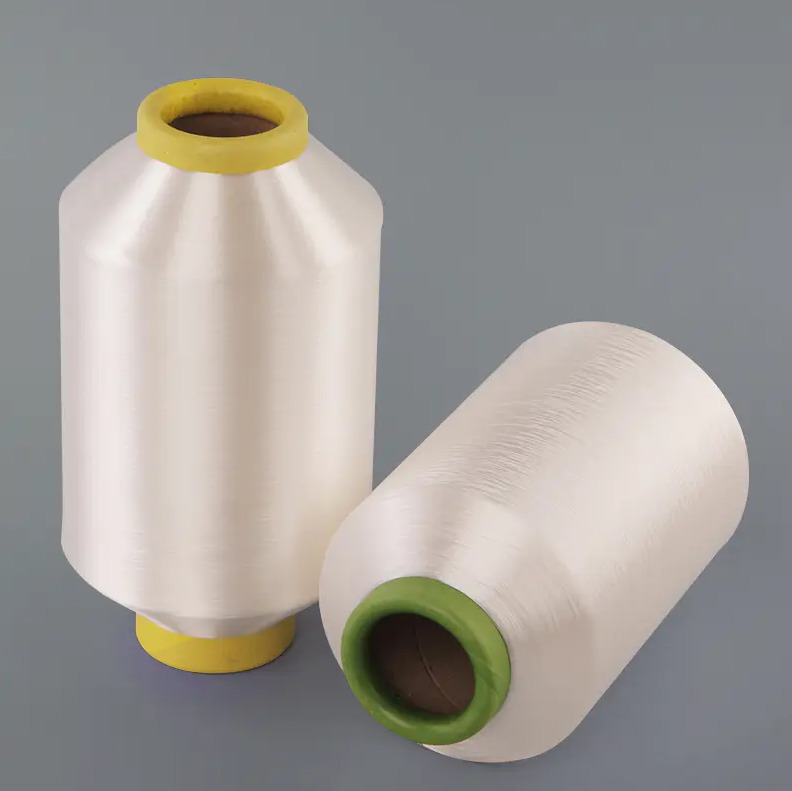
Correct heat activation is the most critical step in working with low melting yarn. Insufficient temperature results in incomplete bonding; excessive heat degrades the base polyester or causes uneven fusion. The following parameters serve as a practical starting point — specific values should always be validated with the yarn supplier's technical data sheet.
Note: Moisture content in the fabric prior to heat activation can cause uneven bonding. Pre-drying the fabric to below 1% moisture uptake is recommended for critical applications.
A common concern about low melting yarn-based fabrics is whether the bonded structure survives repeated washing. The answer depends on the melting point grade selected and the wash temperature used.
In general, once properly activated and cooled, low melting yarn bonds are chemically stable and do not re-melt at typical laundry temperatures (below 60°C for standard household machines). However, tumble drying at high heat settings (above 80°C) may soften lower-grade bonds and should be avoided.
Choosing the correct grade involves matching several technical parameters to your production environment and end-use requirements. Use the checklist below as a starting framework:
Low melting yarn is not the only way to bond textile structures. Understanding how it compares to alternatives helps in making informed material selections.
| Method | Bond Strength | Flexibility After Bonding | Wash Resistance | Environmental Impact |
|---|---|---|---|---|
| Low Melting Yarn | Medium–High | Tunable | Good (grade-dependent) | Low (solvent-free) |
| Hot Melt Adhesive Film | High | Low–Medium | Very Good | Low–Medium |
| Solvent-Based Adhesive | Very High | Low | Excellent | High (VOC emissions) |
| Ultrasonic Welding | High | Low | Excellent | Very Low |
| Stitching / Sewing | Medium | High | Good | Very Low |
Low melting yarn's primary advantage is that it is integrated into the fabric itself, making it invisible and eliminating a separate bonding step in many constructions. Ultrasonic welding offers comparable environmental credentials but requires expensive capital equipment and is limited to flat or simple geometries. Solvent adhesives deliver superior bond strength but are increasingly restricted under environmental regulations in major textile-producing regions.
Reliable performance from low melting 50D polyester yarn requires systematic quality control at both the yarn sourcing stage and during fabric production. Key tests include:
Sustainability has become a key purchasing criterion across the textile supply chain. Low melting polyester yarn has a mixed but generally favorable profile compared to adhesive alternatives:
For products targeting circular economy certifications, specifying a recycled-content low melting yarn and documenting the heat-only bonding process can contribute to lower Scope 3 emissions reporting compared to solvent adhesive alternatives.
It is made with Bio-base PLA, fully biodegradable Feature: 1. Industrial compost product 2. Made with PLA 3. Eco-frie...
READ MOREPlease fill out the form below and our team will contact you as soon as possible.
Addres: No.66 Qiaogang Road, Haian, Nantong City, Jiangsu Province, China
E-mail: service@gcfiber.com admin@gcfiber.com
Copyright ? GC FIBER All Rights Reserved. Eco-Friendly Textile Products Manufacturer Biodegradable Yarn Company