English
 中文简体
中文简体It is made with Bio-base PLA, fully biodegradable Feature: 1. Industrial compost product 2. Made with PLA 3. Eco-frie...
READ MORE
Content
The primary difference between 110°C and 180°C low melting yarn lies in their chemical composition and the specific thermal environment required to trigger their adhesive properties. 110°C yarn is typically a low-melt polyester or copolyamide designed for energy-efficient bonding at lower temperatures, making it ideal for delicate fabrics or heat-sensitive materials. In contrast, 180°C low melting yarn is often a modified high-performance polymer used in heavy-duty industrial applications where superior heat resistance and structural integrity are required after the bonding process is complete.
Choosing between the two depends entirely on your processing equipment and the final use case: 110°C yarn focuses on ease of processing and protecting heat-sensitive substrates, while 180°C yarn focuses on durability and compatibility with high-temperature finishing processes.
To understand which yarn fits your production line, it is essential to look at the technical specifications. The "melting point" refers to the temperature at which the yarn transitions from a solid fiber state to a viscous adhesive state, allowing it to penetrate and bond with surrounding fibers.
| Feature | 110°C Low Melting Yarn | 180°C Low Melting Yarn | |
|---|---|---|---|
| Material Base | Copolyester (CoPES) / Polyamide | Modified Polyester / Specialty Polymer | |
| Softening Range | 90°C - 105°C | 160°C - 175°C | |
| Bonding Strength | Moderate (Flexible) | High (Rigid) | |
| Energy Consumption | Lower | Higher |
The 110°C variant is the most common "standard" low-melt yarn. Its primary advantage is thermal efficiency. Since most steam chambers and industrial ovens can easily reach 110°C-120°C without excessive energy costs or specialized insulation, this yarn is the go-to for mass-market textile production.
One of the most prominent uses is in 3D flying knit shoe uppers. Here, the yarn is knitted into specific zones of the sneaker. Upon heat treatment, it melts to provide structural rigidity and shape retention without making the entire shoe heavy. It is also extensively used in chenille yarn fixing to prevent fiber shedding.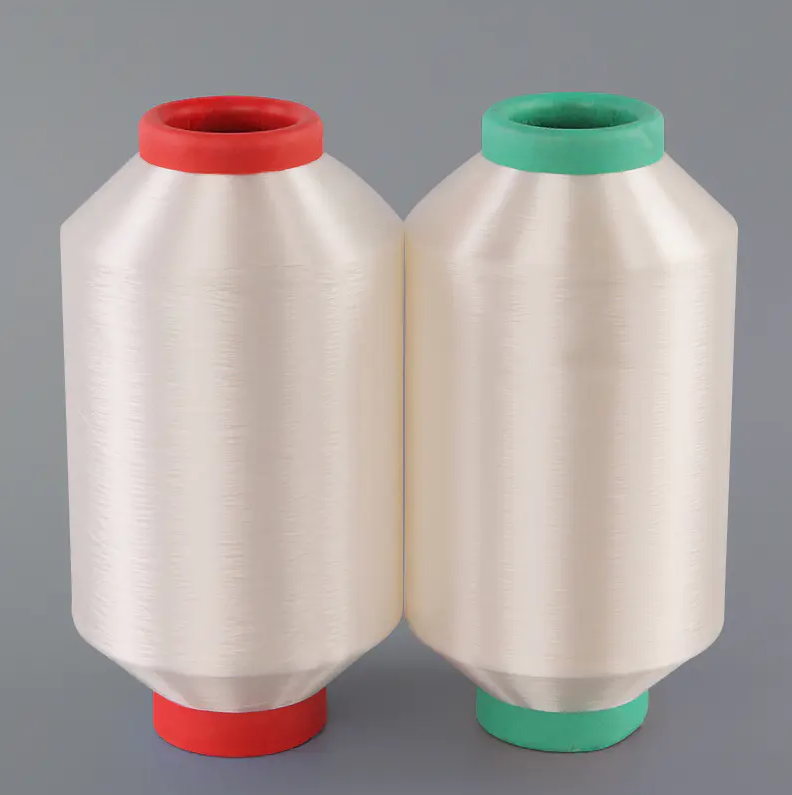
The 180°C low melting yarn exists for environments where 110°C would simply fail. In many industrial dyeing and finishing processes, fabrics are subjected to temperatures exceeding 130°C for stabilization. If a 110°C yarn were used, it would re-melt or lose its adhesive bond during the dyeing cycle, leading to structural collapse.
You will find 180°C yarn in automotive interiors, particularly in headliners and door panels that must endure high cabin temperatures during summer months without delaminating. It is also used in filtration media where hot gases or liquids pass through the fabric, requiring a bond that won't degrade under operational heat.
It is a common misconception that you only need to reach the melting point for a successful bond. In reality, the Effective Bonding Temperature is usually 10°C to 20°C higher than the stated melting point of the yarn.
For 110°C yarn, the equipment (such as a flatbed laminator or steam oven) should ideally operate at 125°C - 130°C to ensure the core of the yarn fully liquefies. For 180°C yarn, processing temperatures often reach 195°C - 200°C. At these higher ranges, the duration of heat exposure (dwell time) becomes critical to prevent the primary "non-melt" fibers in the fabric from degrading.
Pressure is the second variable. Without sufficient pressure, the molten yarn will simply sit on the surface. With pressure, it is forced into the interstices of the neighboring yarns, creating a mechanical and chemical interlock that defines the final product's durability.
Selecting the wrong melting point can lead to two major issues: insufficient bonding (if the heat is too low for the 180°C yarn) or fabric damage (if the heat required for the 180°C yarn melts the rest of the garment). Use the following checklist for your selection process:
The industry is currently moving toward bi-component (Bico) fibers, which often bridge the gap between these temperatures. A bi-component yarn might have a standard polyester core and a 110°C sheath. This allows the yarn to maintain its fiber shape even after the sheath has melted, providing a cleaner look than a 100% low-melt yarn which might "puddle" when liquid.
Furthermore, the push for circularity means that both 110°C and 180°C yarns are now being developed using 100% recycled PET (rPET). This ensures that the thermal bonding benefits—replacing harmful chemical glues—are matched by sustainable raw material sourcing.
It is made with Bio-base PLA, fully biodegradable Feature: 1. Industrial compost product 2. Made with PLA 3. Eco-frie...
READ MOREPlease fill out the form below and our team will contact you as soon as possible.
Addres: No.66 Qiaogang Road, Haian, Nantong City, Jiangsu Province, China
E-mail: service@gcfiber.com admin@gcfiber.com
Copyright ? GC FIBER All Rights Reserved. Eco-Friendly Textile Products Manufacturer Biodegradable Yarn Company